Logmaster Logo
DriverRecord KeeperBusiness OwnerProductsIntegrationsTraining and GuidesAbout UsFind Providers

Safety Management Systems in Australian Transport

Transport businesses hear about safety management systems from two directions: heavy vehicle accreditation and work health and safety. The two share a lot, but they answer to different laws and protect different people.
Ask For InfoBook a Demo
Man working on Logmaster app

TRUSTED BY MORE THAN 10,000 DRIVERS

logmaster supplychainpartners
HHTS logo
AfMA logo
logo
transport 1
HVIA logo

Two Laws, Two Kinds of System

Under the Heavy Vehicle National Law, the Heavy Vehicle Accreditation scheme starts with General Safety Accreditation (GSA). Gaining it requires a safety management system that meets the SMS Standard, which focuses on public risks arising from transport activities and driving.

Work health and safety law starts somewhere else. It places duties on a person conducting a business or undertaking (PCBU) to protect the health and safety of workers and others at the workplace, and a WHS management system is how most businesses organise that work.

The NHVR notes that the two duties may overlap substantially and that many existing controls help with both. It also notes that meeting WHS law doesn't necessarily mean the HVNL primary duty is met.
Logmaster web portal open on a laptop

How the Two Systems Differ

The main differences come down to who is protected, who holds the duty and who oversees it.
Minute-by-minute logging icon

Who is protected

The HVNL focus is public risk from heavy vehicle transport. WHS focuses on workers and others at the workplace.
Less paperwork icon

Who carries the duty

HVNL duties fall on every party in the chain of responsibility. WHS duties fall on the PCBU, with further duties on officers and workers.
Fatigue breach alert icon

Who oversees it

The NHVR grants heavy vehicle accreditation, while WHS laws are enforced by the regulator in each jurisdiction.
Offline mode icon

Where it applies

The HVNL runs in participating states and territories, with WA and the NT outside it. The model WHS laws have been implemented everywhere except Victoria, which has its own law.
Drivers icon

What it's for

An HVNL SMS underpins an accreditation application. A WHS system supports the business's general duty of care to its people.

Where One System Can Serve Both

Many controls do double duty. Building them once and recording them once saves real effort.

Fatigue management

Work and rest limits protect the public on the road and the driver as a worker.

Fitness to drive

A shift-start declaration supports the Unfit to Drive duty and a WHS approach to impairment at the same time.

Hazard reporting

Hazards reported from the cab can feed the risk register under either system.

Incident investigation

One incident process can support the SMS Standard's incident management element and a WHS incident procedure.

Training records

Training and induction records show competency for both regimes.

Vehicle checks

Pre-start and defect records manage risks to the driver and to other road users.

Electronic Work Diary vs Paper Logbook

Fatigue records sit at the centre of both kinds of system in transport. Here's how electronic and paper records compare.
Electronic Work Diary
Paper Logbook
One minute accuracy
Fifteen minute blocks
Automatic syncing
Manual entries
Easy to read and access
Handwriting varies
Real time operator visibility
No live oversight
Secure cloud storage
Can be lost or damaged
Faster audits and reporting
Time consuming
One accurate fatigue record can serve your HVNL SMS and your WHS system at once.
Book a Demo

How It Works

A sensible way to run one safety effort that answers to both laws.
Step 1

Know which apply

Confirm if the business is seeking heavy vehicle accreditation, and which WHS law covers each of your workplaces.
Step 2

Map shared controls

List the controls that serve both regimes, such as fatigue, fitness and incident management.
Step 3

Fill the gaps

Add the elements only one regime asks for, such as the Standard's assurance requirements or WHS consultation duties.
Step 4

Use one set of records

Keep a single record of each check, declaration and incident rather than duplicating them.
Step 5

Assign accountability

Make clear which officers and executives oversee each part.
Step 6

Review together

Review both systems on the same cycle so a change in one is reflected in the other.

Features at a Glance

1. Accurate one minute recording
2. Offline functionality for uninterrupted use
3. Live visibility for fleet managers
4. Fatigue reminders and breach alerts
5. Driver declarations and vehicle checks
6. Secure cloud storage
7. Multi company support for contractors
8. Fast export for audits and reporting
9. Fatigue rule sets including Standard Hours, BFM, AFM, WA plans and bus rules
Book a Demo
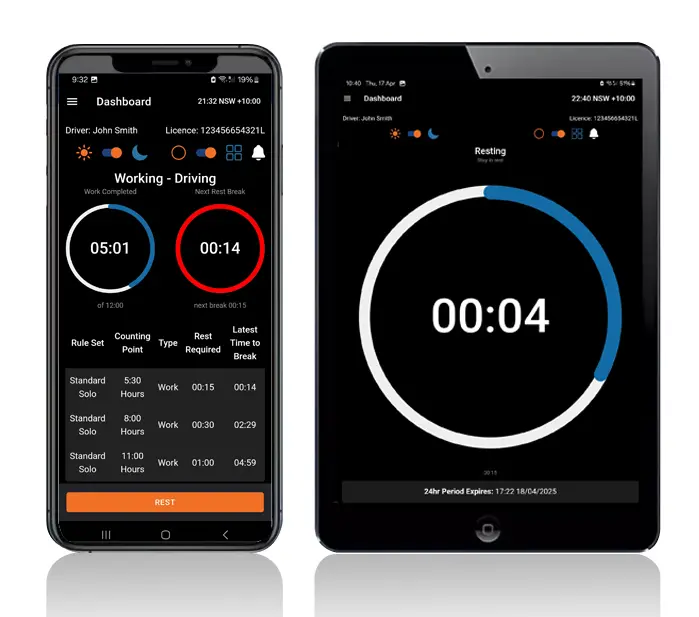
Logmaster app on a phone and tablet

Who It's Built For

Operators of every size can find themselves answering to both regimes, often through the same few people.
User Type
Benefit
Truck drivers
Easier logging and clear alerts
Transport operators
Real time visibility and compliance
Compliance managers
Reliable logs for inspections
Owner drivers
No paperwork and simple routines
Subcontractors
Easy switching between employers
Shared records help a small team keep both systems current.

How Logmaster Supports Both Systems

Logmaster records the controls that both an HVNL SMS and a WHS system lean on: work and rest in an NHVR approved EWD, fitness declarations, pre-starts, incidents, hazards and expiry alerts. Customisable checklists work on mobile and web, and reports and API connectivity get the data to whoever is reviewing it.
Book a Demo
Logmaster dashboard on a desktop screen

Hear from Our Users

Ray A.

First day with Logmaster was to my surprise was user friendly. Josh was very thorough in taking me through all the steps in setting up the Logmaster app. I would recommend Logmaster to all drivers regardless of age. Never have to worry about making a mistake as it tells you if you are. Great customer service after hours support is second to none.

Mike H.

Have started using Logmaster after trying 3 other models. I actually enjoy using it. Very easy to use and follow and the help if you need it is top notch by the developer. Does everything by the minute and works when no service is available. My system is customised for me and fits well with my system (I’m WA). Cost is on par with two of the other ones looked at.

Frequently Asked Questions

Ready to Run One Set of Safety Records?

Book a demo and see how Logmaster's records can support your HVNL safety management system and your WHS system together.

Book a Demo

Download / Updating the app

Get it on Google PlayDownload on the App Store

Support

TRAINING CENTREFREQUENT QUESTIONSPRICING INFORMATION

Resources

Work & Rest RulesFor AuditorsFAQDownload Transport Compliance System BrochureArticles & MediaReseller ResourcesNHVR CertificationISO 27001 CertificationReleasesInvestorsBranded Device BackgroundsJoin Mailing List

Contact us

Level 1/63-73 Ann St, Surry Hills NSW 2010

New Enquiries
(02) 7228 6269
Support and Training
(02) 7228 6266
[email protected]LogmasterISO/IEC 27001 certified