Logmaster Logo
DriverRecord KeeperBusiness OwnerProductsIntegrationsTraining and GuidesAbout UsFind Providers

The Heavy Vehicle National Law, Topic by Topic

New to heavy vehicles? The Heavy Vehicle National Law (HVNL) covers much more than driving hours. This guide takes its main topics one at a time and shows where an electronic work diary fits in.
Ask For InfoBook a Demo
Man working on Logmaster app

TRUSTED BY MORE THAN 10,000 DRIVERS

logmaster supplychainpartners
HHTS logo
AfMA logo
logo
transport 1
HVIA logo

Who and What the HVNL Covers

The HVNL is the main law for heavy vehicles, meaning vehicles with a gross vehicle mass (GVM) over 4.5 tonnes. It sets out duties, limits and offences for the people who drive, load, schedule and send freight in those vehicles.

It runs in the ACT, New South Wales, Queensland, South Australia, Tasmania and Victoria. Western Australia and the Northern Territory have their own rules, but a truck from either one has to follow the HVNL while it's working in a participating state.

Not every part of the law reaches every heavy vehicle. The fatigue rules apply to fatigue-regulated vehicles only: trucks and combinations over 12 tonnes GVM, and buses over 4.5 tonnes built to carry more than 12 adults including the driver.
Logmaster web portal open on a laptop

The Main Topics in the Law

Most of what a newcomer needs to know falls under five headings.
Minute-by-minute logging icon

Fatigue management

Work and rest limits for drivers of fatigue-regulated vehicles, the hours options they can work under, and the work diary and record keeping rules that prove those limits were kept.
Less paperwork icon

Mass, dimension and loading

How heavy a vehicle and its load can be, how long, wide and high it can be, and how the load must be restrained so it can't shift or fall.
Fatigue breach alert icon

Vehicle standards

The construction and performance requirements a heavy vehicle must meet to be safe to use on the road.
Offline mode icon

Chain of Responsibility

Safety duties for everyone whose decisions affect a heavy vehicle on the road, from the business sending the goods to the person writing the roster.
Drivers icon

Accreditation

A voluntary scheme that lets operators with a proven safety management system use alternative arrangements, such as their own approved fatigue hours.

Where Newcomers Often Get Caught Out

A few parts of the law are easy to misread when you're starting out.

Two weight lines, not one

Work diary rules start at 12 tonnes, yet the Unfit to Drive duty reaches every heavy vehicle driver over 4.5 tonnes, whatever the reason they're unfit.

The 100km boundary

Under Standard Hours, a driver who stays within 100km of base doesn't need a work diary. The operator keeps local area records for that work instead.

Duties beyond the cab

A business that only books freight or runs a loading dock still has duties under the law, even if it never employs a driver.

Accreditation is a choice

Operators can run under Standard Hours and general mass limits without any accreditation. It's needed only for alternative arrangements such as approved fatigue hours.

Paper or electronic diaries

Drivers who need a work diary can use the written National Driver Work Diary or an NHVR approved electronic work diary (EWD). Neither is required over the other.

WA runs its own system

In Western Australia, fatigue is managed under work health and safety law by WorkSafe WA, and businesses need a driver fatigue management plan.

Electronic Work Diary vs Paper Logbook

Fatigue is the topic that shows up on every shift, and the work diary is where it's recorded. This is how the two kinds of diary compare.
Electronic Work Diary
Paper Logbook
One minute accuracy
Fifteen minute blocks
Automatic syncing
Manual entries
Easy to read and access
Handwriting varies
Real time operator visibility
No live oversight
Secure cloud storage
Can be lost or damaged
Faster audits and reporting
Time consuming
The law accepts either one. What changes is how much of the counting and writing is left to the driver.
Book a Demo

How It Works

A new operator usually gets set up under the HVNL in roughly this order.
Step 1

Check your vehicles

List each vehicle's GVM so you know which are heavy vehicles and which are fatigue-regulated.
Step 2

Pick an hours option

Most new operators start on Standard Hours. Alternative hours come later, through accreditation.
Step 3

Choose a work diary

Decide between the written diary and an approved EWD for drivers who work beyond 100km.
Step 4

Name a record keeper

Someone has to hold diary and local area records and make them available when asked.
Step 5

Map your chain

Write down who loads, schedules, sends and receives your freight, so each party's role is clear.
Step 6

Review your loads

Check mass and dimension limits for each vehicle and how loads are restrained.

Features at a Glance

1. Accurate one minute recording
2. Offline functionality for uninterrupted use
3. Live visibility for fleet managers
4. Fatigue reminders and breach alerts
5. Driver declarations and vehicle checks
6. Secure cloud storage
7. Multi company support for contractors
8. Fast export for audits and reporting
9. Fatigue rule sets including Standard Hours, BFM, AFM, WA plans and bus rules
Book a Demo
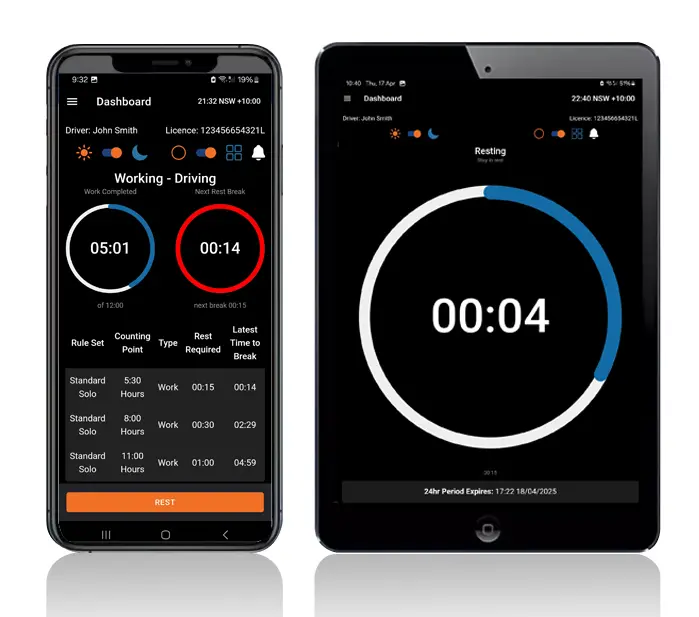
Logmaster app on a phone and tablet

Who It's Built For

Duties under the HVNL fall on people well away from the driver's seat, from schedulers to the businesses that receive the goods.
User Type
Benefit
Truck drivers
Easier logging and clear alerts
Transport operators
Real time visibility and compliance
Compliance managers
Reliable logs for inspections
Owner drivers
No paperwork and simple routines
Subcontractors
Easy switching between employers
Logmaster supplies the fatigue records that each of them can rely on.

Starting Out With Logmaster

Fatigue is usually the first part of the HVNL a new operator has to get right, because it touches every working day. Logmaster's NHVR approved EWD applies the limits for each driver's plan, reminds them before a break is due and gives the office the same record. Drivers can run it on Android or Apple devices, and it keeps recording without phone signal.
Book a Demo
Logmaster dashboard on a desktop screen

Hear from Our Users

Ray A.

First day with Logmaster was to my surprise was user friendly. Josh was very thorough in taking me through all the steps in setting up the Logmaster app. I would recommend Logmaster to all drivers regardless of age. Never have to worry about making a mistake as it tells you if you are. Great customer service after hours support is second to none.

Mike H.

Have started using Logmaster after trying 3 other models. I actually enjoy using it. Very easy to use and follow and the help if you need it is top notch by the developer. Does everything by the minute and works when no service is available. My system is customised for me and fits well with my system (I’m WA). Cost is on par with two of the other ones looked at.

Frequently Asked Questions

Ready to Get Fatigue Right From Day One?

Book a demo and see how Logmaster handles the fatigue side of the HVNL while you get the rest of your business set up.

Book a Demo

Download / Updating the app

Get it on Google PlayDownload on the App Store

Support

TRAINING CENTREFREQUENT QUESTIONSPRICING INFORMATION

Resources

Work & Rest RulesFor AuditorsFAQDownload Transport Compliance System BrochureArticles & MediaReseller ResourcesNHVR CertificationISO 27001 CertificationReleasesInvestorsBranded Device BackgroundsJoin Mailing List

Contact us

Level 1/63-73 Ann St, Surry Hills NSW 2010

New Enquiries
(02) 7228 6269
Support and Training
(02) 7228 6266
[email protected]LogmasterISO/IEC 27001 certified