
A lot of people in the industry are hearing “HVNL reform” and really need to make a start on understanding it. The most useful way to approach it is to separate (1) what has changed in law, (2) what the regulator is signalling, and (3) what you need to do operationally so you can demonstrate compliance.
This initial guide is written for transport operators and compliance managers. It is an executive summary and a reading guide, not legal advice. The aim is to help you quickly understand the direction of travel and what to pay attention to.
Logmaster will follow with a series on the HVNL reforms, so if this one is too broad a start, stay tuned.
1) Start with the law (HVNL amendments)
What it is:
The Heavy Vehicle National Law (HVNL) is the legal framework that sets the rules for fatigue management, Chain of Responsibility (CoR), and record keeping. Recent reforms amend the law. This is the source-of-truth layer: everything else sits underneath it. Why it matters to operators:
If your compliance posture is built on assumptions from the “old era” (paper-first processes, late data, after-the-fact checking), the reforms generally push you toward earlier intervention, better evidence, and more defensible processes.
Go to this link to access the bill:
https://www.parliament.qld.gov.au/Work-of-Committees/Committees/Committee-Details
The NHVR’s much shorter FAQ:
https://www.nhvr.gov.au/files/media/document/809/202512-1685-hvnl-implementation-faqs.pdf
2) Then read the regulator’s practical interpretation (NHVR guidance and codes)
The NHVR publishes guidance material and Codes of Practice that explain how it interprets duties and what it expects good compliance to look like in practice. This is the “how you’ll be judged” layer.
Why it matters to operators:
Even where the law’s wording is broad (e.g., CoR duties, reasonable steps), the regulator’s published guidance is often the closest thing to a practical checklist. It is also the language auditors and investigators tend to use when asking for evidence.
Where to read it:
NHVR Codes of Practice page
https://www.nhvr.gov.au/safety-accreditation-compliance/codes-of-practice
NHVR HVNL reform information page (high-level summaries and updates):
https://www.nhvr.gov.au/about-us/heavy-vehicle-national-law-reform
See Also the new Master Code of Practice, which has transitioned from a role-based structure to an activity-based structure:
https://www.nhvr.gov.au/safety-accreditation-compliance/industry-codes-of-practice/2026-master-code
3) What operators should focus on
The reforms matter because they change expectations around evidence, control, and accountability. In practical terms, transport operators should be asking:
A) Do we have defensible evidence of work and rest?
- Can you produce clear records quickly if asked?
- Are records complete, consistent, and easy to audit?
- If you rely on paper, do you have delays, gaps, or corrections that become hard to defend later?
B) Are we proactive or retrospective?
- Are you detecting risk (approaching breaches, patterns, non-conformances) early enough to act?
- Or are you discovering problems after the fact—when you are already exposed?
C) Is responsibility clear across the chain?
- Can you show what the business did to prevent unsafe scheduling and fatigue risk?
- Can you show what supervisors/allocators did, not just what the driver did?
D) Can we explain our system to an auditor in one hour?
- A strong compliance system isn’t one that has more documents; it’s one that can be understood, verified, and evidenced quickly.
4) How to use this as a starting point
If you’re starting from scratch, do this in order:
- Read the HVNL amendments (the law).
- Read the NHVR’s published guidance and Codes of Practice to understand expectations.
- Compare those expectations to your current operational reality: how you schedule, how you record, how you investigate, and how you produce evidence.
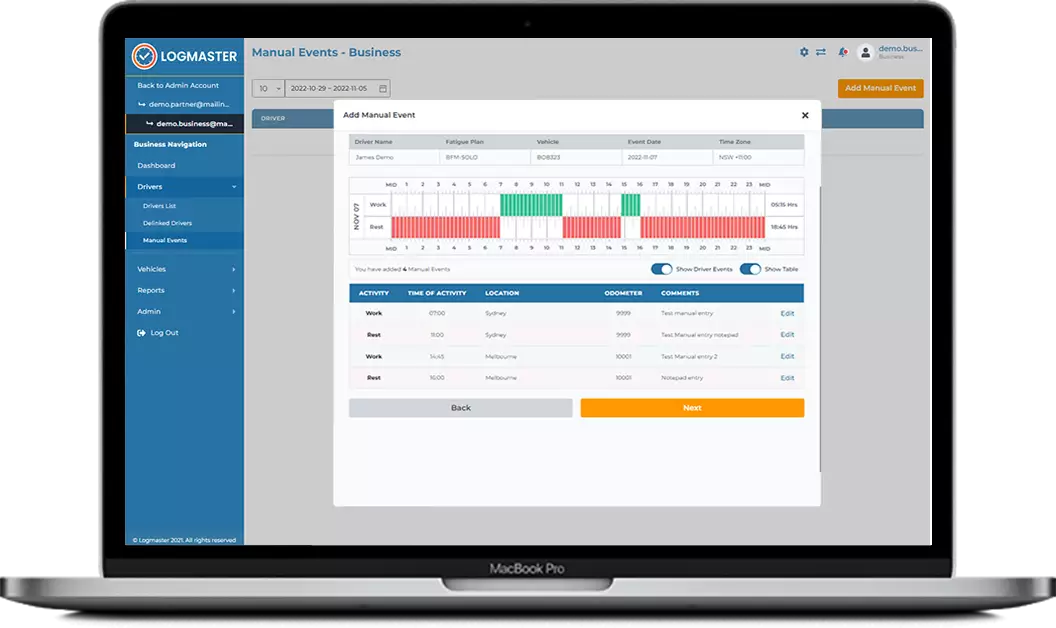
From there, you can evaluate tools (including EWDs) based on whether they reduce compliance risk and admin burden while improving the quality of evidence your operations is creating.
Closing note
The biggest mistake operators make during reform periods is waiting for “final clarity” before tightening processes. In practice, reforms usually increase expectations around evidence and duty-of-care long before everyone feels ready. If you can strengthen your record quality, improve visibility, and reduce retrospective admin, you are moving in the right direction.
Subscribe to receive articles as Logmaster lays out more detail in coming weeks.